


Advice on learning progression and what to do 'next'

Comments

Do any of the people you sometimes play with feel like-minded, and might want to start a band?
In all honesty no I wouldn't think so.
It's more of an acoustic blues thing, but I have no incling any of them would want to do more.
But I do enjoy playing with them, even though we do super simple stuff.
It's more of an acoustic blues thing, but I have no incling any of them would want to do more.
But I do enjoy playing with them, even though we do super simple stuff.


Buy a Trio+ pedal and use it to practice your play along style while you look for others to play with.
I've seen that place yeah, in fact the guy have lessons with has a link to it on his website!HAL9000 said:
I honestly don't know where I'd stand with it. I don't feel confident to just turn up and play something, maybe I should go along as see how good (or bad!) everyone else is.

I image it would be quite difficult to just turn up if you don't know where all the chords and notes reside. I mostly play my own stuff, but I find that having some knowledge of music theory helps a lot. Lately, I have been using the Scaler VST app to explore extended music keys, and I usually write down which chords and scales are available to me in a particular key. A little bit of music theory can go a long way, and you can get some impressive results once you learn about voicings, variations & modulation, etc. (the app helps with this).

To summarise, you know the basics and you’re taking first steps into soloing. You’ve got a teacher, which will be a great sounding board and should get you up the ladder with the fingers and brain bits more quickly than without one.MrDazzle said:Hi,
I'm not sure if this question belongs in theory, playing live, or somewhere else so please humour me as necessary.
I've owned at least one guitar for ~20 years now and I've gone through periods of playing them loads and periods of not playing them at all. I've never played to a 'real' audience, not even 10 people, but I've jammed with other people off and on too. Been 'off' for a long time now though!
Having turned 40 earlier this year I decided to have a mid life crisis and try to learn properly. Up until now I've just done the YouTube and Tabs style of learning, I have proper lessons now. I'm really enjoying learning more of the theory about how and why music fits together. At the moment I'm mainly learning how to solo / improve blues.
I'm struggling with where to go with it. Ultimately I'd like to be able to play with a group of people to another group of people and not have any of them hate it :lol: That's my main aim here really, I want to be able to perform on the guitar at least a bit.
I have lessons every week and I go a group lesson / jam session every month, but that's very casual and totally unplugged. I've been thinking about trying to find somewhere else to go and/or some other people to play with too but I'm a bit stuck really.
Any advice on what I should be doing?
Your objective is to play confidently with others, which I assume means playing over changes without needing a chord sheet in advance and
And for experience, that’s simply a question of playing loads, and playing with others in particular. Consciously pay attention to what sounds good and what doesn’t in terms of what you’re playing (and not playing) while others are doing their own thing.
Assuming I’ve got all that right then what’s missing is ear training and sheer experience.
To a degree you can do ear training entirely on your own, but like everything you’ll go quicker with help and structure. Essentially you want to get so used to hearing sounds and pitches and intervals that you can hear them in your head and then apply them to the fretboard. What you’ll eventually reach is a point where playing any melody is as simple as singing it.
Your teacher should definitely be able to help with that, but stuff like Rick Beato’s ear training course (others are no doubt also available) would help. In reality though, just transcribing solos is a great way to do this - it’s what all the greats did. Listen to music over again and work out where the notes are. Do this enough and it’ll becoming a quick process. Do it even more and it’ll become second nature and possible in real-time.
And for experience, that’s simply a question of playing loads, and playing with others in particular. Consciously pay attention to what sounds good and what doesn’t in terms of what you’re playing (and not playing) while others are doing their own thing.
Good luck!!
This is part of why I don't know where I stand :lol:
I know what a 12 bar blues is for example, which chords you'd play for a given key etc. I know how major and minor pentatonic fit around that, where you find those scales at different positions on the neck. I know what gospel slides are, what a BB king box is, lots of things like that which is what my teacher has been teaching me.
I know what people mean by a minor 3rd, or a 2 5 1 progression or that sort of thing, I can (after a little thought) put it into action. :D I even know a bit about what modes are.
I've actually picked up more than I thought in terms of theory in the time I've been (sort of) playing the guitar.
But if someone says "right lets play something!" I'd probably go "errrrrrrr......." :D
I know what a 12 bar blues is for example, which chords you'd play for a given key etc. I know how major and minor pentatonic fit around that, where you find those scales at different positions on the neck. I know what gospel slides are, what a BB king box is, lots of things like that which is what my teacher has been teaching me.
I know what people mean by a minor 3rd, or a 2 5 1 progression or that sort of thing, I can (after a little thought) put it into action. :D I even know a bit about what modes are.
I've actually picked up more than I thought in terms of theory in the time I've been (sort of) playing the guitar.
But if someone says "right lets play something!" I'd probably go "errrrrrrr......." :D
We’ve cross-posted so I hope mine above is helpful!MrDazzle said:This is part of why I don't know where I stand
I know what a 12 bar blues is for example, which chords you'd play for a given key etc. I know how major and minor pentatonic fit around that, where you find those scales at different positions on the neck. I know what gospel slides are, what a BB king box is, lots of things like that which is what my teacher has been teaching me.
I know what people mean by a minor 3rd, or a 2 5 1 progression or that sort of thing, I can (after a little thought) put it into action.I even know a bit about what modes are.
I've actually picked up more than I thought in terms of theory in the time I've been (sort of) playing the guitar.
But if someone says "right let’s play something!" I'd probably go "errrrrrrr......."

But I’ll add - I don’t know what those bold things are. Frankly I’m shaky on modes. But I will happily jam with anyone - my main band did our singer’s wedding last friday and went down a storm. I honestly haven’t a clue what i was doing academically, but I knew what notes I needed to play to make the songs happen melodically and harmonically. And my other band is 100% improv jams so far - none as any idea what’s going to happen each time we get in a room and that’s incredible.
The biggest skill that drives that is focusing on playing melodies above all else. Then bringing in the theory later when I need to talk about it with others, or need to apply the same ideas to a different harmonic structure.
Your head is clearly in the right place and it sounds like you’re making good technical progress, so keep at it 
and never stop asking questions - there’s ALWAYS something new to learn
and never stop asking questions - there’s ALWAYS something new to learn
Honestly, if you know your twelve-bar chords then you’ll be good. Just go along and watch first time and see how things work (personally I’d throw a guitar in the boot just in case). The normal way of blues jams is that someone will lead a scratch band for two or three numbers. Then another group of musicians will take their turn and so it goes on. So most of the time you’ll be playing chords (which it sounds like you already know). You certainly won’t have to sing or be front stage, and when it’s time to take a solo you can always indicate to pass if you don’t feel up to it. At any jam I’ve been to people have always been encouraging and want you to succeed, but no-one will mind if it all goes tits up - well, you might but that’s about the extent of it. Above all these events are about having fun.MrDazzle said:I've seen that place yeah, in fact the guy have lessons with has a link to it on his website!HAL9000 said:
I honestly don't know where I'd stand with it. I don't feel confident to just turn up and play something, maybe I should go along as see how good (or bad!) everyone else is.

MrDazzle said:This is part of why I don't know where I stand :lol:
I know what a 12 bar blues is for example, which chords you'd play for a given key etc. I know how major and minor pentatonic fit around that, where you find those scales at different positions on the neck. I know what gospel slides are, what a BB king box is, lots of things like that which is what my teacher has been teaching me.
I know what people mean by a minor 3rd, or a 2 5 1 progression or that sort of thing, I can (after a little thought) put it into action. :D I even know a bit about what modes are.
I've actually picked up more than I thought in terms of theory in the time I've been (sort of) playing the guitar.
But if someone says "right lets play something!" I'd probably go "errrrrrrr......." :D
But people don't go "right let's play something" and the conversation stops there. They might say "let's play Crossroads" or "blues in Am, follow me for the changes" or "funky groove like Sex Machine" an infinite number of things really. I guess in a pure jam environment people will just play and more importantly listen and react.
It is difficult to understand what the problem is practically and precisely. What have you tried to do in practice that you have not been able to?
This is an interesting way of doing things, although it does sound a bit like walking on a tightrope without a safety net! I've been influenced by formal art classes where you first sketch your subject, and then prepare a colour palette in advance before you start painting. It does seem like something I should look into though, albeit somewhat daunting.stickyfiddle said:We’ve cross-posted so I hope mine above is helpful!But I’ll add - I don’t know what those bold things are. Frankly I’m shaky on modes. But I will happily jam with anyone - my main band did our singer’s wedding last friday and went down a storm. I honestly haven’t a clue what i was doing academically, but I knew what notes I needed to play to make the songs happen melodically and harmonically. And my other band is 100% improv jams so far - none as any idea what’s going to happen each time we get in a room and that’s incredible.The biggest skill that drives that is focusing on playing melodies above all else. Then bringing in the theory later when I need to talk about it with others, or need to apply the same ideas to a different harmonic structure.Your head is clearly in the right place and it sounds like you’re making good technical progress, so keep at it
and never stop asking questions - there’s ALWAYS something new to learn
Yep…Vintage65 said:This is an interesting way of doing things, although it does sound a bit like walking on a tightrope without a safety net! I've been influenced by formal art classes where you first sketch your subject, and then prepare a colour palette in advance before you start painting. It does seem like something I should look into though, albeit somewhat daunting.stickyfiddle said:We’ve cross-posted so I hope mine above is helpful!But I’ll add - I don’t know what those bold things are. Frankly I’m shaky on modes. But I will happily jam with anyone - my main band did our singer’s wedding last friday and went down a storm. I honestly haven’t a clue what i was doing academically, but I knew what notes I needed to play to make the songs happen melodically and harmonically. And my other band is 100% improv jams so far - none as any idea what’s going to happen each time we get in a room and that’s incredible.The biggest skill that drives that is focusing on playing melodies above all else. Then bringing in the theory later when I need to talk about it with others, or need to apply the same ideas to a different harmonic structure.Your head is clearly in the right place and it sounds like you’re making good technical progress, so keep at it
and never stop asking questions - there’s ALWAYS something new to learn
Thing is I do understand a lot of theory and academic stuff, I’m just not thinking about it when I’m playing.
One interesting example I was once told was how kids learn vs adults. Kids don’t worry about theoretical stuff in any way shape or form - they just jump in and do stuff - and they’re usually far quicker at learning than adults, at least in the early stages. Whereas adults want to spend loads of time on understanding the “why” before they nervously start doing anything, and are often terrified of doing anything for fear of failure
Which isn’t to say you shouldn’t sketch out roughly the broad strokes of what you want to do in advance. But you’re never more than a semitone away from an in-key note, so the jeopardy is pretty low ;)
Ha....I never thought of it like that before, but I suppose you're right :lol:stickyfiddle said:Which isn’t to say you shouldn’t sketch out roughly the broad strokes of what you want to do in advance. But you’re never more than a semitone away from an in-key note, so the jeopardy is pretty low ;)
When I first started trying to do improv solo stuff under tutelage I only heard the duff notes sometimes, then I started hearing them every time and quickly trying to recover, now I instinctively move in the 'right direction'. Maybe soon I won't hit the duff notes at all.
You’ll never hit none. Where you want to end up is to only hit them when properly improvising (rather than trying to play something very specific), and then learn to lean into the “atonal” bits by playing them again and making it intentional :)MrDazzle said:Ha....I never thought of it like that before, but I suppose you're right :lol:stickyfiddle said:Which isn’t to say you shouldn’t sketch out roughly the broad strokes of what you want to do in advance. But you’re never more than a semitone away from an in-key note, so the jeopardy is pretty low ;)
When I first started trying to do improv solo stuff under tutelage I only heard the duff notes sometimes, then I started hearing them every time and quickly trying to recover, now I instinctively move in the 'right direction'. Maybe soon I won't hit the duff notes at all.

Like StickyFiddle above - I have no idea what gospel slides are? Is that sliding a chord up a semitone? I've heard of gospel chords - where you play a triad with an altered bass note as in a G/A found in that style of music.topdog91 said:MrDazzle said:This is part of why I don't know where I stand
I know what a 12 bar blues is for example, which chords you'd play for a given key etc. I know how major and minor pentatonic fit around that, where you find those scales at different positions on the neck. I know what gospel slides are, what a BB king box is, lots of things like that which is what my teacher has been teaching me.
I know what people mean by a minor 3rd, or a 2 5 1 progression or that sort of thing, I can (after a little thought) put it into action.
I've actually picked up more than I thought in terms of theory in the time I've been (sort of) playing the guitar.
But if someone says "right lets play something!" I'd probably go "errrrrrrr......."
But people don't go "right let's play something" and the conversation stops there. They might say "let's play Crossroads" or "blues in Am, follow me for the changes" or "funky groove like Sex Machine" an infinite number of things really. I guess in a pure jam environment people will just play and more importantly listen and react.
It is difficult to understand what the problem is practically and precisely. What have you tried to do in practice that you have not been able to?
And being strictly pedantic - you're more likely to hear someone call out a Blues in A rather than a blues in A minor - (and slightly easier to play over since you're not having to worry about the dominant major 7th chord as the V chord changes wise - though hitting the G# and you're all good right?!).
This thread reminds me a little of another thread on here where the OP basically listed the contents of 20 years worth of jazz theory that would have Joe Pass scratching his head and asking what people recommend he do with it?

If it's any help, I asked the teacher what they've got to do with Gospel and he didn't know.
I'd definitely heard them before too when he showed me. That seems to happen a lot, he tells me about a concept and then shows me whereupon I just go "oh right, like that bit in XXX". I bet loads of the stuff he's teaching is stuff many people know by a different name, or perhaps no name at all. "It's just that thing where you do this....*plays little lick*"
I'd definitely heard them before too when he showed me. That seems to happen a lot, he tells me about a concept and then shows me whereupon I just go "oh right, like that bit in XXX". I bet loads of the stuff he's teaching is stuff many people know by a different name, or perhaps no name at all. "It's just that thing where you do this....*plays little lick*"

You say your learning solos and improvising blues and using TABs. I wouldn't use TABs it's like painting by numbers and most of the TAB I have seen isn't right. I've been teaching guitar and bass for over twenty years so I have seen a lot of it.
It's just my opinion but I always teach chords and inversions as a bass to solo on. Yes I do scales. I also do specific solos.
Blues is very basic but the most important part of it is feel. I would suggest widening your choice of music so you can utilise
and further you chord vocabulary this will also develop your hearing what is going on in a particular piece of music.
Try and listen to some jazz standards or pop standards . Motown and soul is good to check out. It's good to be able to know if your hearing a 7th or a major 7 or diminished change etc.
If I teach a song I will right it down ( just chords ) but I feel it's better to learn to remember chords because if you lost a piece of paper with the chords on would it mean you can't play the song ! Develop your memory as this will improve your playing.
Before someone chimes in with what about learning a song yes that fine and no different than doing a session but normally
two or three times is normally OK. The other important thing worth learning is the Nashville numbering system it can make life easier. If you have a guitar teacher he should be able to help with all this . Good luck.
It's just my opinion but I always teach chords and inversions as a bass to solo on. Yes I do scales. I also do specific solos.
Blues is very basic but the most important part of it is feel. I would suggest widening your choice of music so you can utilise
and further you chord vocabulary this will also develop your hearing what is going on in a particular piece of music.
Try and listen to some jazz standards or pop standards . Motown and soul is good to check out. It's good to be able to know if your hearing a 7th or a major 7 or diminished change etc.
If I teach a song I will right it down ( just chords ) but I feel it's better to learn to remember chords because if you lost a piece of paper with the chords on would it mean you can't play the song ! Develop your memory as this will improve your playing.
Before someone chimes in with what about learning a song yes that fine and no different than doing a session but normally
two or three times is normally OK. The other important thing worth learning is the Nashville numbering system it can make life easier. If you have a guitar teacher he should be able to help with all this . Good luck.
I was learning that way when self taught, but not with the teacherPAL said:You say your learning solos and improvising blues and using TABs.
That's part of why I went for 'real' lessons, to understand better the proper theory of how this all works rather than just learning music by rote via TAB.
I think "blues in A" is covered by "an infinite number of things". I myself prefer minor blues as there are fewer (reasonable) options which makes me feel better about not using more of the options. ;)CaseOfAce said:Like StickyFiddle above - I have no idea what gospel slides are? Is that sliding a chord up a semitone? I've heard of gospel chords - where you play a triad with an altered bass note as in a G/A found in that style of music.topdog91 said:
But people don't go "right let's play something" and the conversation stops there. They might say "let's play Crossroads" or "blues in Am, follow me for the changes" or "funky groove like Sex Machine" an infinite number of things really. I guess in a pure jam environment people will just play and more importantly listen and react.
It is difficult to understand what the problem is practically and precisely. What have you tried to do in practice that you have not been able to?
And being strictly pedantic - you're more likely to hear someone call out a Blues in A rather than a blues in A minor - (and slightly easier to play over since you're not having to worry about the dominant major 7th chord as the V chord changes wise - though hitting the G# and you're all good right?!).
Yeah, tell him you asked on tFB and we said they're not a thing. ;)MrDazzle said:If it's any help, I asked the teacher what they've got to do with Gospel and he didn't know.
I'd definitely heard them before too when he showed me. That seems to happen a lot, he tells me about a concept and then shows me whereupon I just go "oh right, like that bit in XXX". I bet loads of the stuff he's teaching is stuff many people know by a different name, or perhaps no name at all. "It's just that thing where you do this....*plays little lick*"
I actually googled them as soon as I got home because I was curious where the name came from.
Deffo a thing.
https://www.justinguitar.com/guitar-lessons/blues-gospel-slide-chords-bl-207
BTW I didn't know what a BB King box was, but as soon as he showed me Peter Greens opening solo to Need your love so bad I knew what he meant.
Deffo a thing.
https://www.justinguitar.com/guitar-lessons/blues-gospel-slide-chords-bl-207
BTW I didn't know what a BB King box was, but as soon as he showed me Peter Greens opening solo to Need your love so bad I knew what he meant.
oh it's that.. Yeah I know what you mean now.MrDazzle said:I actually googled them as soon as I got home because I was curious where the name came from.
Deffo a thing.
https://www.justinguitar.com/guitar-lessons/blues-gospel-slide-chords-bl-207
BTW I didn't know what a BB King box was, but as soon as he showed me Peter Greens opening solo to Need your love so bad I knew what he meant.
It's the Steely Dan / Chain Lightning thing.
I've seen Robben Ford do a similiar thing.
Well - that's clears that up!
The BB King box thing is the "shape" that he uses to play over a 12 bar and outline the changes solely in that position using the notes and bends right? Instantly recognisable when you hear it.
Yeah it's this.CaseOfAce said:The BB King box thing is the "shape" that he uses to play over a 12 bar and outline the changes solely in that position using the notes and bends right? Instantly recognisable when you hear it.
My teacher has cottoned on to the fact I tend to pick this things up best when they're contextualised in a song I know. So for this Need Your Love So Bad is perfect, 'cause I can just hear that tune in my head.
In fact just by chance this little pic is the box in A innit, which is where you use it for said song.
I am at the point now where I can play that actual song fairly reliably, so now when I go to the little acoustic meet up I'm given the task of improving a solo using this box, but in some other key. Sometimes if I'm feeling particularly adventurous I'll stray off into the convenient minor pentatonic scale next door. :lol:
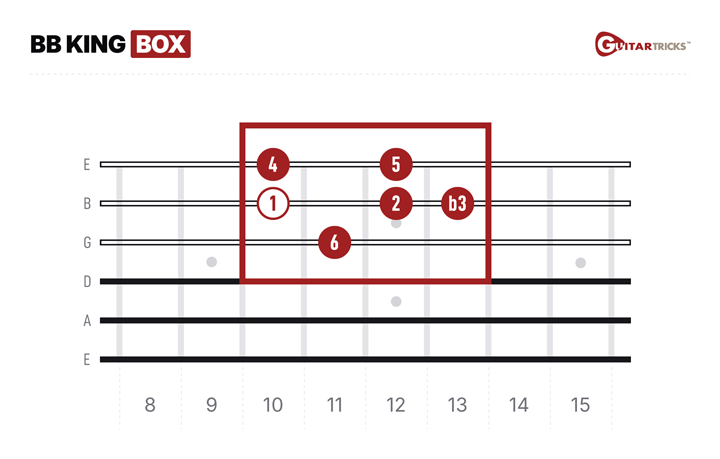
Going back to the blues jam thing… If you know your major and minor pentatonics and the BB box then I can almost guarantee that you have more knowledge than half of the players there. Ok, knowledge isn’t the same as stringing a solo together but you’ve certainly got all the building blocks already. Like I said before, go along and watch what goes on. Nothing ventured and all that…

I would suggest joining a band if your aim is to play to an audience. You should learn a lot from playing with others (not just theory, but timing and musicality) and have fun in the process.
Learn a number of songs and, providing they don’t include iconic solos that an audience expects to be close to the recording, then attempt improvising. If you hit a duff note, make sure you end on a correct sounding note. It’s easy to get too hung up on the theory, and not focus on things like phrasing, bending notes, etc.

I’ve been watching this thread wondering how I could politely say JDI. Playing with other people you quickly realise that your musical knowledge and playing abilities are perfectly adequate for the job in hand. You just need to do it.CarpeDiem said:I would suggest joining a band ...
I do have a cheat sheet app on my tablet, but I suppose that's cheatingYep…Vintage65 said:This is an interesting way of doing things, although it does sound a bit like walking on a tightrope without a safety net! I've been influenced by formal art classes where you first sketch your subject, and then prepare a colour palette in advance before you start painting. It does seem like something I should look into though, albeit somewhat daunting.
Thing is I do understand a lot of theory and academic stuff, I’m just not thinking about it when I’m playing.
One interesting example I was once told was how kids learn vs adults. Kids don’t worry about theoretical stuff in any way shape or form - they just jump in and do stuff - and they’re usually far quicker at learning than adults, at least in the early stages. Whereas adults want to spend loads of time on understanding the “why” before they nervously start doing anything, and are often terrified of doing anything for fear of failure
Which isn’t to say you shouldn’t sketch out roughly the broad strokes of what you want to do in advance. But you’re never more than a semitone away from an in-key note, so the jeopardy is pretty low
https://i.ibb.co/s1PPqx6/Screenshot.jpg
My attitude to theory is more curiosity that anything else TBH.
I don't think it's necessary to know it all, but there's always the old cliché "no one ever became a worse player by learning some theory".
But from my POV I just enjoy knowing why things work. It's the same for everything in my life not just music, I just like knowing thy WHY of everything.
I don't think it's necessary to know it all, but there's always the old cliché "no one ever became a worse player by learning some theory".
But from my POV I just enjoy knowing why things work. It's the same for everything in my life not just music, I just like knowing thy WHY of everything.
Yep, it’s a useful step, but if you rely on it then you’re short changing yourself. If you are a visual learner then you need to be able to see the pattern in your mind when you look at the fretboard. With practice your fingers will get to know their positions without looking.Vintage65 said:I do have a cheat sheet app on my tablet, but I suppose that's cheating
I'm not sure if this question belongs in theory, playing live, or somewhere else so please humour me as necessary.
I've owned at least one guitar for ~20 years now and I've gone through periods of playing them loads and periods of not playing them at all. I've never played to a 'real' audience, not even 10 people, but I've jammed with other people off and on too. Been 'off' for a long time now though!
Having turned 40 earlier this year I decided to have a mid life crisis and try to learn properly. Up until now I've just done the YouTube and Tabs style of learning, I have proper lessons now. I'm really enjoying learning more of the theory about how and why music fits together. At the moment I'm mainly learning how to solo / improve blues.
I'm struggling with where to go with it. Ultimately I'd like to be able to play with a group of people to another group of people and not have any of them hate it :lol: That's my main aim here really, I want to be able to perform on the guitar at least a bit.
I have lessons every week and I go a group lesson / jam session every month, but that's very casual and totally unplugged. I've been thinking about trying to find somewhere else to go and/or some other people to play with too but I'm a bit stuck really.
Any advice on what I should be doing?