


Thinking about Nuts

Comments

Interesting post, @DavidR.
My 2c: I've never paid much attention to nuts. But then, as a matter of habit, I take any new guitar into visit the chap who fettles them for me (and made two of them) and he does whatever he thinks is a good idea, sometimes involving nut-tweaking, sometimes not. Costs peanuts in the context of things.
I pretty much never have tuning stability problems, but then I'm not much of a string bender, though I do have a heavy right hand.
As for tuners - absolutely! People fetishise them to no good purpose. I'm fussy about exact tuning and am perfectly happy with any good quality factory standard tuner.
My 2c: I've never paid much attention to nuts. But then, as a matter of habit, I take any new guitar into visit the chap who fettles them for me (and made two of them) and he does whatever he thinks is a good idea, sometimes involving nut-tweaking, sometimes not. Costs peanuts in the context of things.
I pretty much never have tuning stability problems, but then I'm not much of a string bender, though I do have a heavy right hand.
As for tuners - absolutely! People fetishise them to no good purpose. I'm fussy about exact tuning and am perfectly happy with any good quality factory standard tuner.

I haven’t seen the article but nuts are fundamental to tuning stability and I’ve lost track of how many times I’ve said it over the last couple of years.
Nut slots are almost always cut narrower and/or v-shaped than they need to be and it’s the biggest source of tuning problems and leads to the widely repeated “Gibsons just don’t stay in tune” nonsense

@DavidR On your classical you'll get a better angle on the A, D, G and B strings if you wind them "in" to wards the centre of the headstock. Also rather than having nice winds with all the coils tightly together let them spread out. Doesn't look as good but you'll get a better angle at the nut and less friction.
Yes. That photo of classical is from www not mine. Whoever stringed that could have considered string angles a bit more, and that bottom E is set to buzz I think!
Sorry didn't realise :)
The tuners for slotted headstocks could be better design as well if they moved the holes closer to the centre for the A, D, G and B strings.
The tuners for slotted headstocks could be better design as well if they moved the holes closer to the centre for the A, D, G and B strings.

In the first pic, you'd actually get straighter string pull if the E strings went round the posts the 'wrong' way.

That's why I always wind the two E strings toward the middle of the headstock.DavidR said:
Lastly, I was taught a long time ago that, when tuning a classical, you need to make sure that the string does not hit the edge of the cut slot in the slot-head classical design. If necessary (all makers differ) you need to be prepared to wind on the 2 E strings inside the string hole rather than the outside. Checking my classical (Ramirez 125anos) I have done that and yet the bottom E string is still in contact with the wood; and it increases the angle I have been banging on about above.
I also put as little winding on the rollers as possible by pulling the strings tight by hand before tying them on, which reduces the amount of stretching-in they need and seems to give better tuning stability.

The angle that the strings leave the rear of the nut and go to their respective tuner posts is a very common cause of tuning instability on 3 + 3 headstocks on electric guitars where strings are being bent all the time. It causes far less problems on an acoustic guitar, but still can be an issue. It creates a sideways break angle on the string and often causes additional friction at that point, especially for the wound strings. One of the resolutions is to smoothly file out the rear of the string slot so that it flares out towards the direction that the string goes to the tuners.
Well illustrated and written article:
https://hazeguitars.com/blog/troubleshooting-tuning-the-nut
If you can't get sufficient winds onto the barrel / roller of a nylon strung guitar without the string rubbing against the edge of the headstock slot, wind the string onto the barrel to one side of the hole to start with then across the hole to the other side. Through experimentation you will be able to get enough winds (especially for the unwound strings) on the barrel to prevent slipping while controlling the angle it travels to the nut.
Definitive article. Thanks @BillDL

I'm going to invest in some decent nut files next year and get practicing!
The guitar tech I've been using cannot seem to get it right, yet he seems adept at fretwork and repairs in general. Every time he touches a nut on my guitars, they come back with worse tuning stability and binding issues. He now offers advice on lubrication, fretting with less pressure and general suggestions that it's all in my head and simply the nature of guitars :s
That sounds like he’s getting something fundamental wrong with the shaping of the grooves. There are three main wrong ways, two of which cause tuning problems…Cryptid said:The guitar tech I've been using cannot seem to get it right, yet he seems adept at fretwork and repairs in general. Every time he touches a nut on my guitars, they come back with worse tuning stability and binding issues. He now offers advice on lubrication, fretting with less pressure and general suggestions that it's all in my head and simply the nature of guitars :s
The groove is too wide and with a flat bottom - this doesn’t cause tuning problems, but the string can ‘ping’ when bending notes as it jumps from one side to the other.
The groove is slightly triangular, so the string isn’t supported at the bottom and jams between the sides. This is the worst for tuning trouble.
The groove is the right shape - rounded at the bottom - but exactly the same width as the string, using the ‘correct size’ file. Contrary to what you might expect, this is wrong - it causes a lot of friction because there’s a large contact area between the nut and the string, right around the bottom half of the string. The groove needs to be wider than the string - even quite substantially is fine, the string will still centre itself in the bottom of the groove, but now the contact is just there and nowhere else. A little bit of lubricant and it will move freely.
If he’s a professional with the right tools, I’m guessing it’s the third one - but have a close look at the grooves.

I use a StringButler on my acoustic headstock which purports and seems to make things better here
I also wonder why the high E and Low E tuning pegs arent wound the other way to get a better line through - ha ent given it much thought though and just occurred to me on the train
I also wonder why the high E and Low E tuning pegs arent wound the other way to get a better line through - ha ent given it much thought though and just occurred to me on the train
Thanks for clarifying - I've been suspecting that this is the case. He definitely has the right tools and I can't really fault his other work. If I were to use him again, do you think it'd be an idea to ask for the slots to be filed for a higher gauge i.e. 13s when I use 12s?ICBM said:
The groove is the right shape - rounded at the bottom - but exactly the same width as the string, using the ‘correct size’ file. Contrary to what you might expect, this is wrong - it causes a lot of friction because there’s a large contact area between the nut and the string, right around the bottom half of the string. The groove needs to be wider than the string - even quite substantially is fine, the string will still centre itself in the bottom of the groove, but now the contact is just there and nowhere else. A little bit of lubricant and it will move freely.
If he’s a professional with the right tools, I’m guessing it’s the third one - but have a close look at the grooves.
I've been using Nut Sauce lubricant which helps a little, but nothing makes me want to put a guitar down quicker than tuning instability.
I really should learn to do this myself, it'd be incredibly satisfying to get it right and not waste more money and time. I imagine it's very easy to go too far though!
I really should learn to do this myself, it'd be incredibly satisfying to get it right and not waste more money and time. I imagine it's very easy to go too far though!

Just so I've understood this point correctly, would that be an inverted triangle as you look down the barrel of the string, as it were?ICBM said:
The groove is slightly triangular,
Lovely, thanks @Jonathangus
Yes, although even that probably isn't enough if he's actually trying to make the grooves the same width as the string gauges.Cryptid said:
If I were to use him again, do you think it'd be an idea to ask for the slots to be filed for a higher gauge i.e. 13s when I use 12s?
What's slightly frustrating is that there is so much wrong information out there - for example this:
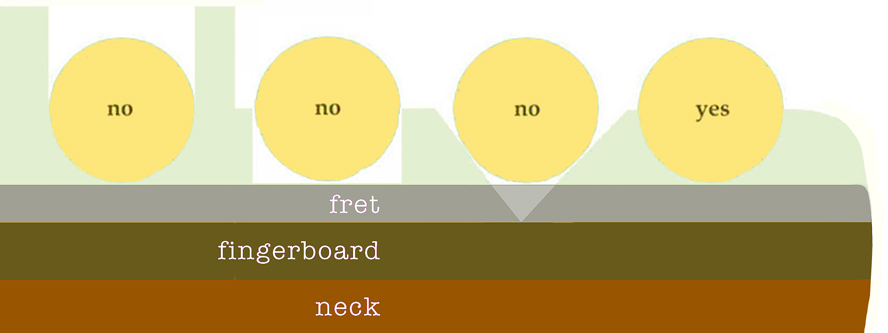
The pic on the left is *not* wrong - at least not for the reason they mean - contrary to what you will often read, the height of the nut above the centreline of the string makes no difference at all, because by definition it cannot be touching the string, and doesn't cause any problems.
However, both this and the pic on the right are wrong because the groove is too tight and will cause a lot of friction - the whole surface of the bottom half of the string is rubbing against the nut.
*This* - however crudely drawn it is! - is correct:
I’m learning a lot from my OP! Thanks @ICBM
ICBM is 100% correct as usual (and agreeing with my earlier post, natch ;) )
I have lost count of the number of times I’ve had the argument with people who swear this is wrong.
@cryptid I go a “full string up”, so if I’m filing for anything from 9s to 11s I’ll use a 13 file for the e, 16/17 on the b, 24 on the g, etc
That also means you can go up or down string gauges pretty easily with no ill effect.
I have lost count of the number of times I’ve had the argument with people who swear this is wrong.
@cryptid I go a “full string up”, so if I’m filing for anything from 9s to 11s I’ll use a 13 file for the e, 16/17 on the b, 24 on the g, etc
That also means you can go up or down string gauges pretty easily with no ill effect.
I knew someone would do that :). Although he should really have a ‘shrug’ expression ;).BillDL said:
@ICBM @stickyfiddle @BillDL
Really appreciate the great info and clarity on the 'dark art' of nut filing, thank you. I now feel well-informed to ask a tech exactly what I would like them to do, and eventually give it a shot myself when armed with the proper tools.
This set me off thinking a bit more about nuts and looking at my own instruments from this perspective.
A perfect nut would have the grooves set at the right height and the right width. Nut slots which are too high will make an instrument less comfortable to play and will cause a note to go sharp as you push down the string. Nut slots smaller than your string will add friction to the string as it passes through and hinder tuning. For some reason, I have a couple of instruments where this is a problem on the wound D and G strings and I must pay them some attention I think. I have tried a lot of cheap files for nut work over the years and none have been even one quarter as good as the specific acoustic nut files like the Guitar Nomad ones. A set makes a good life long investment even though they are a bit expensive.
Secondly, an ideal string would approach the nut from above at no sideways angle and with a slight downward angle to ensure contact. On 3R 3L tuners (most acoustics) this is rarely true, especially for the 2 E strings. I wonder how often manufacturers consider this fact. Looking at my 4 acoustics, NONE of the strings approach the nut straight. The tidiest looking one is the Vintage. The Regal resonator is a close second but the distance between the first tuner pegs and the nut is 6cm on that, as opposed to approx. 5cm on the 3 others, and that must reduce the angles. On all 4 the headstock gets wider towards the top which only increases all these angles. I have never been a fan of the Seagull headstocks but now I can see the logic of them. They may not be aesthetically as pleasing (?) but, design-wise, they're bang on in terms of nut/string angle because the tuner pegs are more aligned with the nut slots....
Lastly, I was taught a long time ago that, when tuning a classical, you need to make sure that the string does not hit the edge of the cut slot in the slot-head classical design. If necessary (all makers differ) you need to be prepared to wind on the 2 E strings inside the string hole rather than the outside. Checking my classical (Ramirez 125anos) I have done that and yet the bottom E string is still in contact with the wood; and it increases the angle I have been banging on about above.
To what extent does any of this matter? Some I think. The main point of the article was to encourage us to look at nut issues and not the tuners if we are finding an instrument above averagely difficult to keep in tune.
You never stop learning do you.
:-)