


Capacitor values on coil split

Comments

Doing that will retain less treble, not more - the high frequencies from the second coil will go directly to ground.
Ah, is there a way to use a capacitor, or something else to achieve what I want?ICBM said:Doing that will retain less treble, not more - the high frequencies from the second coil will go directly to ground.
You would need to use an inductor (choke).Ah, is there a way to use a capacitor, or something else to achieve what I want?
Please tell me more....currently there's a DPDT and on one side it takes the split to ground via my trimpot, on the other side it takes the split wire to live via my trimpot.ICBM said:You would need to use an inductor (choke).Ah, is there a way to use a capacitor, or something else to achieve what I want?
What does the choke consist of, and could I introduce it into that set up?
A choke is a small coil, usually with a ferrite core. It’s essentially the opposite of a capacitor in that it presents a low impedance to low frequencies and a high impedance to high ones. I have absolutely no idea what value you would need, I’ve never even thought about it before...andyg_prs said:
What does the choke consist of, and could I introduce it into that set up?
A choke does have the possible advantage of having an inherent DC resistance, which could possibly be in a useful range to not bother with the resistor, but again I don’t know for sure, I’m just coming to it from a theory point of view.
I’m not even sure if the result would be useful or if it’s better just to reduce the value of the resistor, which itself gives a brighter sound.

In general, you can use capacitors in series with the signal to cut low end in guitar wiring, but because the two coils of a humbucker are typically in series with each other, there's no good way to do that on only one coil.

You can add an RC high pass filter to the output of the pickup when it's operating in split mode and bypassed when not with a bit of switching ... basically this is a resistor in parallel to the output (or trim pot) and a capacitor in series. To calculate the value of the cutoff frequency it's fc = (1/2πRC) You can use an online RC filter calculator to muck around with the values but bear in mind the value of the resistor, which is in parallel needs to be high enough not to load the pickup.
Hi,Danny1969 said:You can add an RC high pass filter to the output of the pickup when it's operating in split mode and bypassed when not with a bit of switching ... basically this is a resistor in parallel to the output (or trim pot) and a capacitor in series. To calculate the value of the cutoff frequency it's fc = (1/2πRC) You can use an online RC filter calculator to muck around with the values but bear in mind the value of the resistor, which is in parallel needs to be high enough not to load the pickup.
So the PRS pickups only have a single wire for the split. In the diagram below, one of the wires is the split wire, and then the other wire is either going to hot or ground depending on the pickup.
Is it like this, or something else, or is it not possible due to the the single split wire?
I think maybe everything here is in series - Split wire > wiper of trimpot > terminal of trimpot >capacitor > output (ground in the diagram)?
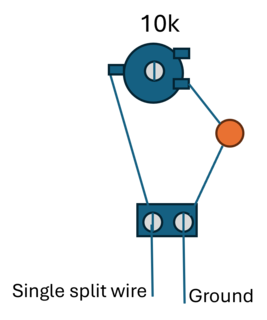
Apologies for my ignorance....
I'm using a 10k trimpot on my PRS HFS, VB humbuckers when I coil split. Not sure of the exact selected value as I think I'd have to unwire the pickups to measure etc.
The more of the split coil I retain, the meatier the sound - of course, because it's closer to a full humbucker.
So I want to retain some treble or lose some bass......which is what I think a capacitor can do, but not 100% clear on the mechanism.
I think what I need to do it place a capacitor effectively across the legs of the trimpot, but in reality I'd probably do it like this.....cue one of my naff diagrams, showing just one humbucker.
Is this correct? And what cap values? I'd rather start with more extreme in terms of less bass / more treble and then go more subtle after if I need.
Thanks,
Andy