


CNC advice thread
Comments
I think @gizmo ; has posted some bits (hmm, user not found)
I've been looking into it a lot recently and am pretty set on a Ultimate bee with xPro V5 controller and a 2.2Kw air spindle.
I've watched a lot of construction vids for the machine, and started to do some guitar design in Fusion360.
Now i just need the spare change to pay for it
I've been looking into it a lot recently and am pretty set on a Ultimate bee with xPro V5 controller and a 2.2Kw air spindle.
I've watched a lot of construction vids for the machine, and started to do some guitar design in Fusion360.
Now i just need the spare change to pay for it
https://www.thefretboard.co.uk/discussion/252061/cad-cam-tips-thread/p1
https://www.thefretboard.co.uk/discussion/259872/my-consolidated-build-thread-works-in-progress-cnc-stuff#latest
https://www.thefretboard.co.uk/discussion/259872/my-consolidated-build-thread-works-in-progress-cnc-stuff#latest
Don't buy a K2 unless you're more interested in rebuilding a CNC machine than in using it.
Useful stuff - thanks for digging out those threads.
I am almost certainly not going to do huge amounts of material removal - as you would need to do for a guitar body, so my needs are a bit more modest. The Ooznest is AFAICS a commercially made version of the Workbee design mentioned in those threads.
The Genmitsu range has some with ball-screws and stepper motors at not bad prices: https://www.sainsmart.com/products/proverxl-4030-v2
Will look up "K2" so I can see what to avoid!
I am almost certainly not going to do huge amounts of material removal - as you would need to do for a guitar body, so my needs are a bit more modest. The Ooznest is AFAICS a commercially made version of the Workbee design mentioned in those threads.
The Genmitsu range has some with ball-screws and stepper motors at not bad prices: https://www.sainsmart.com/products/proverxl-4030-v2
Will look up "K2" so I can see what to avoid!
You might see one used - I'm pretty sure they went bust. It's usable but I built an entire new control box for it and rewired the whole thing after the original caught fire in normal use. There are some structural compromises too.
Workbee kits are pretty reasonably priced on aliexpress
For a first CNC, I need to stick to something well-sorted from the start. Problem solving the technology plus a steep learning curve plus getting to grips with the software would need more time than I want to spend.
So my list is quite simple:
* quick build time
* ball-screw
* stepper motors
* option for bigger spindle/Makita router
* ply/MDF being 90% of the work
* very simple lightweight aluminium work on occasion
I'm mainly struggling with deciding on the work area at the moment.
So my list is quite simple:
* quick build time
* ball-screw
* stepper motors
* option for bigger spindle/Makita router
* ply/MDF being 90% of the work
* very simple lightweight aluminium work on occasion
I'm mainly struggling with deciding on the work area at the moment.
Looking at your list, the one thing I would say, don't go for a CNC that has an electric router too noisy, go for a machine that has a water cooled spindle they run almost silent and providing it's got the power something like 2.2 kW will be more than sufficient. Also, these water cooled spindle can run for long periods at a time, whereas something like a small Makita will burn itself out quite quickly.
The link below is of a machine similar to a CNC that a friend of mine had, there was very little work to do to get it set up and working. It's very well-made, although he is only doing simple work on it, it does run for seven or eight hours a day, no problem. They're several versions of it available with different size spindles, the only thing to look out for is make sure the spindle takes half inch tooling. I would also recommend a minimum size of 6090. There are lots of versions of this machine around all under different names, but basically all the same machine. There is a 4 axis version of the machine that's about £1500, this one has got a 2.2 kW water cold spindle. Of course you don't have to use the fourth axis.
https://www.amazon.co.uk/dp/B0DBD2ZMPB/ref=sspa_dk_detail_5?psc=1&pd_rd_i=B0DBD2ZMPB&pd_rd_w=1umuU&content-id=amzn1.sym.46187d6a-4306-4bc6-830c-7b2085e0e39f&pf_rd_p=46187d6a-4306-4bc6-830c-7b2085e0e39f&pf_rd_r=SJFS1VGN78EE58F9AEY8&pd_rd_wg=0nmfK&pd_rd_r=d443031e-d078-4651-baef-a379a7cbeed5&s=diy&sp_csd=d2lkZ2V0TmFtZT1zcF9kZXRhaWw
The link below is of a machine similar to a CNC that a friend of mine had, there was very little work to do to get it set up and working. It's very well-made, although he is only doing simple work on it, it does run for seven or eight hours a day, no problem. They're several versions of it available with different size spindles, the only thing to look out for is make sure the spindle takes half inch tooling. I would also recommend a minimum size of 6090. There are lots of versions of this machine around all under different names, but basically all the same machine. There is a 4 axis version of the machine that's about £1500, this one has got a 2.2 kW water cold spindle. Of course you don't have to use the fourth axis.
https://www.amazon.co.uk/dp/B0DBD2ZMPB/ref=sspa_dk_detail_5?psc=1&pd_rd_i=B0DBD2ZMPB&pd_rd_w=1umuU&content-id=amzn1.sym.46187d6a-4306-4bc6-830c-7b2085e0e39f&pf_rd_p=46187d6a-4306-4bc6-830c-7b2085e0e39f&pf_rd_r=SJFS1VGN78EE58F9AEY8&pd_rd_wg=0nmfK&pd_rd_r=d443031e-d078-4651-baef-a379a7cbeed5&s=diy&sp_csd=d2lkZ2V0TmFtZT1zcF9kZXRhaWw
^ Interesting - although that's the sort of nameless Chinese router I was trying to ignore. In case of poor post-sales support, lack of spares, etc. But it looks very good value - ball screws, etc.
On the water-cooled spindle, it's a £250ish upgrade for some of the Genmitsu machines, and was on my upgrade path if necessary.
Size-wise, I do not intend to carve guitars.
On the water-cooled spindle, it's a £250ish upgrade for some of the Genmitsu machines, and was on my upgrade path if necessary.
Size-wise, I do not intend to carve guitars.
There's a lot of videos on YouTube about that particular type of CNC. There's also a couple of long-term reviews as well. Might be worth having a look at.
Having another think about these. Decided now that it would be useful to get a large work area (and a PITA to have to change that later).
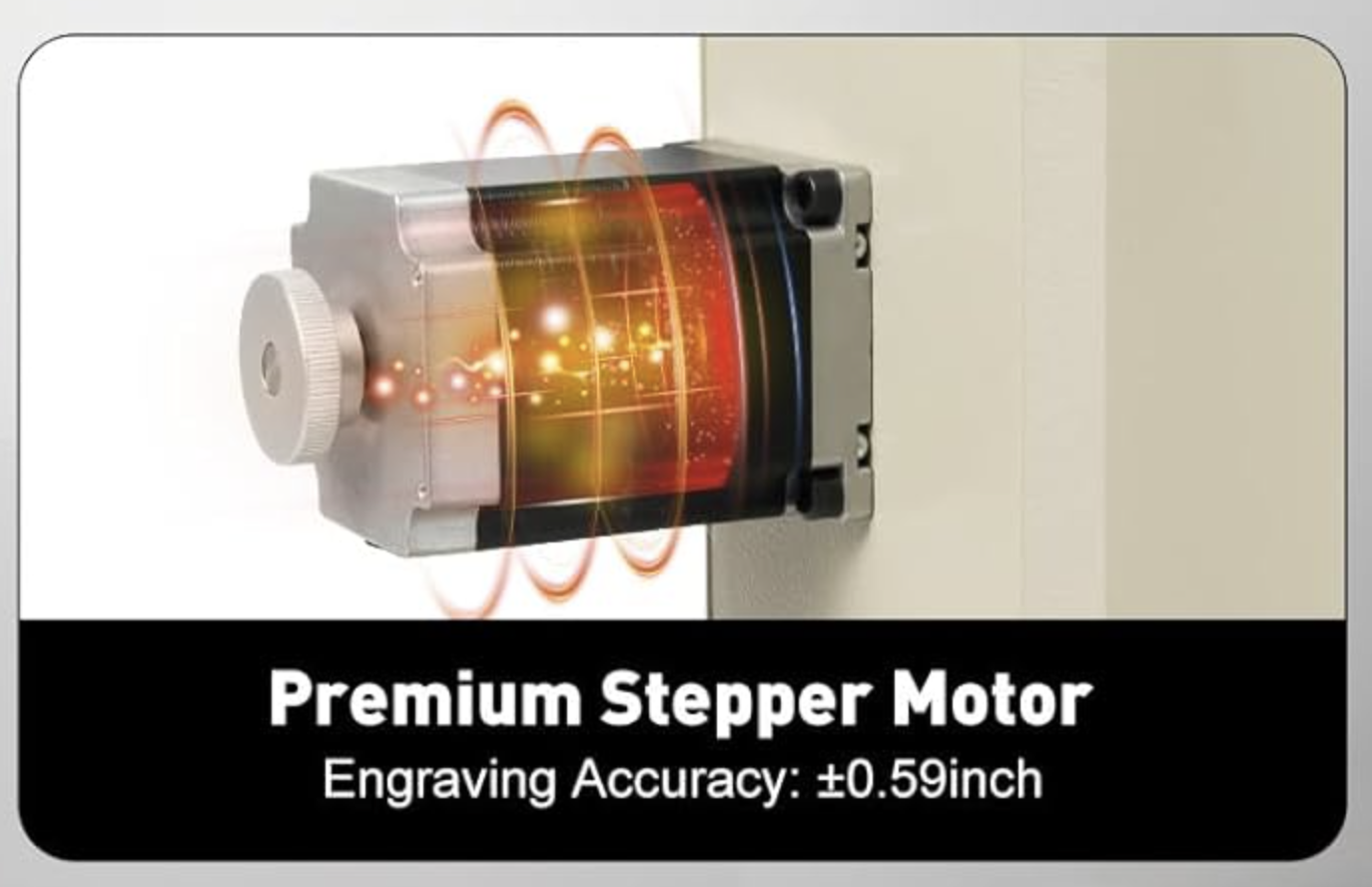
The main thing that deters me from the Chinese ones (the Amazon one above, and same 'medical beige' ones all over Ebay) is the question of support. I just suspect it's flakey and a case of 'sort it out yourself' if problems arise. Seeing the sloppy attention to detail in the advert doesn't inspire confidence:
I am now persuaded by the linear rails before/after videos I've seen - specifically deflection changes as the machine slows down causing these errors in corners:

I suppose slowing down the X/Y speed and/or reducing the load would reduce that, at the expense of cutting time.
The main thing that deters me from the Chinese ones (the Amazon one above, and same 'medical beige' ones all over Ebay) is the question of support. I just suspect it's flakey and a case of 'sort it out yourself' if problems arise. Seeing the sloppy attention to detail in the advert doesn't inspire confidence:
I am now persuaded by the linear rails before/after videos I've seen - specifically deflection changes as the machine slows down causing these errors in corners:
I suppose slowing down the X/Y speed and/or reducing the load would reduce that, at the expense of cutting time.
goldtop said:
 surely that tolerance is a typo. +/- (just over) 1/2 inch! Even if it’s meant to be 0.59mm it still seems a lot to me!
Exactly, trying to second guess the typo they've made there, and what they really mean is tricky.
I think for my first machine, I need a supplier with more handholding and support. Maybe later, once I've wised up, I'll be more able to support myself.
I think for my first machine, I need a supplier with more handholding and support. Maybe later, once I've wised up, I'll be more able to support myself.
Unless you spend significantly more than the machines that have already been mentioned in the this thread, then you're going to have to largely support yourself.
Anything that runs on aluminium profile at those price points, is going to have compromises.
Whether those compromises are acceptable, depends on what exactly you plan on doing with the machine.
I've not got time to go through all the machines listed, but if there's anything specific that you want critiqued, I'll have a look and list the key weak points.
However, if you have the option, always go for a water cooled spindle.
The majority of noise from an air cooled router comes from the open air cooled design, removing that source of noise goes from having a machine screaming continually which you'd need to shout to hear anybody speak nearby, to a machine that the only sound is from the cutter and you can have a pretty normal conversation nearby.
This is my current CNC router-
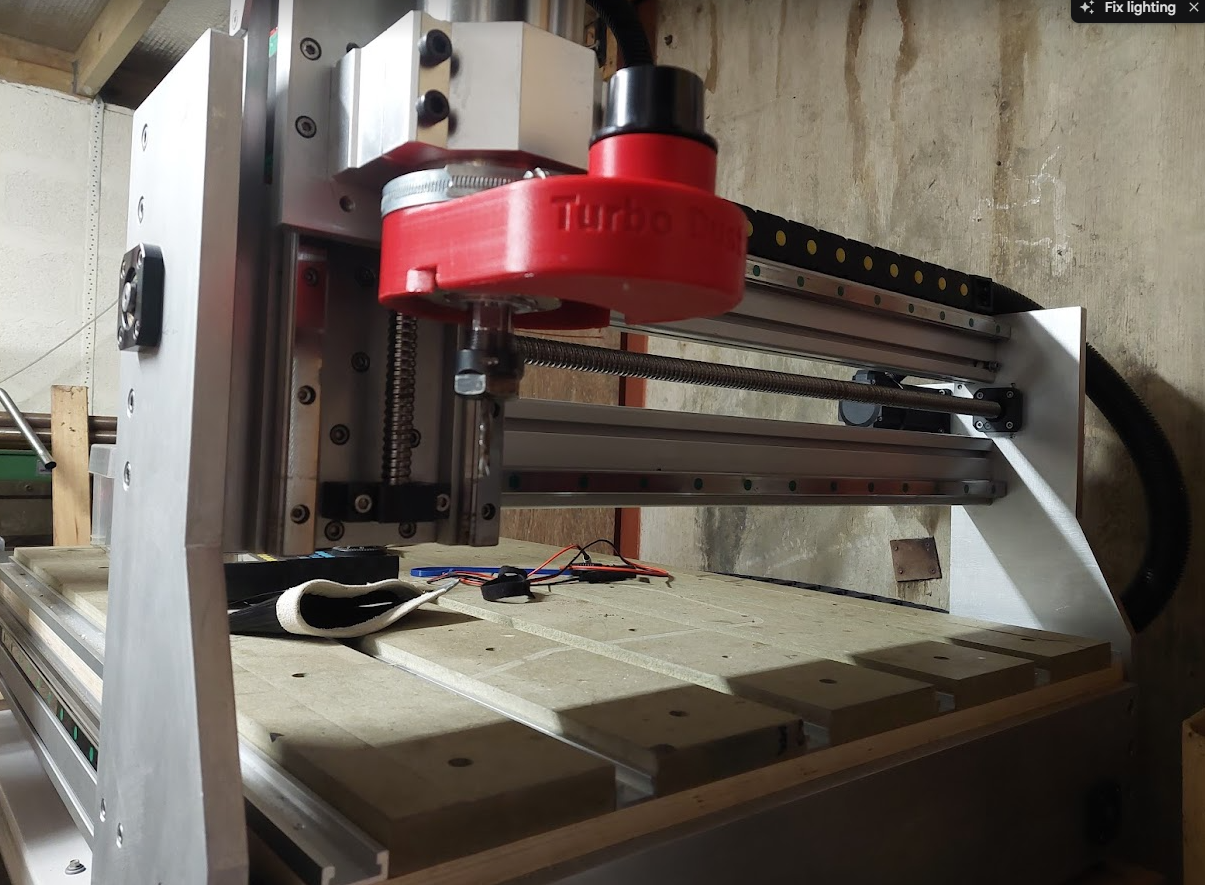
Doesn't look that big in the photo, but it has 1060 by 710mm travel, and I mostly use it to profile 30mm thick beech using 10mm cutters.
Anything that runs on aluminium profile at those price points, is going to have compromises.
Whether those compromises are acceptable, depends on what exactly you plan on doing with the machine.
I've not got time to go through all the machines listed, but if there's anything specific that you want critiqued, I'll have a look and list the key weak points.
However, if you have the option, always go for a water cooled spindle.
The majority of noise from an air cooled router comes from the open air cooled design, removing that source of noise goes from having a machine screaming continually which you'd need to shout to hear anybody speak nearby, to a machine that the only sound is from the cutter and you can have a pretty normal conversation nearby.
This is my current CNC router-
Doesn't look that big in the photo, but it has 1060 by 710mm travel, and I mostly use it to profile 30mm thick beech using 10mm cutters.
Yup - 30mm hardwood with 10mm cutters is far beyond my use case, which is sheet ply/MDF in up to 12mm thickness. Minimal 3D carving.
The current machine I am looking at is the linear-rails-upgraded XE Pro:
https://www.foxalien.com/products/cnc-router-machine-xe-pro-with-xy-linear-rails-upgrade-kit
It looks like there's no 1.5kW spindle upgrqde for that one, though. Still deliberating.
The current machine I am looking at is the linear-rails-upgraded XE Pro:
https://www.foxalien.com/products/cnc-router-machine-xe-pro-with-xy-linear-rails-upgrade-kit
It looks like there's no 1.5kW spindle upgrqde for that one, though. Still deliberating.
As a side note, it looks like I will have to get a Windows machine (or dust off my old one) to run the CNC software. Few of the affordable options come in MacOS versions. Easel Free (browser-based) might just work for me, but seems right on the borderline between useful/under-powered.
Fusion 360 is an option, but I wish it was more modular, so you didn't have to buy the complete do-everything feature set.
Fusion 360 is an option, but I wish it was more modular, so you didn't have to buy the complete do-everything feature set.
One way of avoiding that happening is when you write the tool Path to do a pocket, write the initial program with the pocket smaller than it's going to be, say by 1 mm, them right the tool Path for the pocket the correct size, this should eliminate what has happened in that photo above.goldtop said:Having another think about these. Decided now that it would be useful to get a large work area (and a PITA to have to change that later).
The main thing that deters me from the Chinese ones (the Amazon one above, and same 'medical beige' ones all over Ebay) is the question of support. I just suspect it's flakey and a case of 'sort it out yourself' if problems arise. Seeing the sloppy attention to detail in the advert doesn't inspire confidence:
I am now persuaded by the linear rails before/after videos I've seen - specifically deflection changes as the machine slows down causing these errors in corners:
I suppose slowing down the X/Y speed and/or reducing the load would reduce that, at the expense of cutting time.
It's many years since I've was writing these type of programs. The software at the time would automatically cut the pocket under size and then go back re-cut at the correct size.
You can also write Micro programs that you can call up at any time to cut pockets, so if you're doing neck pockets or pick up pockets it's already written, You just call it into the program at the appropriate time. As can we drilling holes you can write a program called pecking. This basically means you drill in 1 mm pull back 1 mm then drilling 2 mm and pull back 1 mm, keep doing this until you reach the desired depth.
I have a Genmitsu I got one of the first ones they did originally 4030 now I have upgraded it over the years.
As much as you may hear people moan about Chinese support for me they have been very good.
They replaced the early machine I had for a full version of their new model improved stepper and drivers and said the first gen was not a product they were proud of. I had a few small issues but they did it without out me even having to ask.
Also one of the drivers blew out on the control box during Covid and they expressed me a new one 3 day service from China in lockdown here in Spain so no complaints on the support front.
Depending on what you are doing I would not get too hung up on linear rails Acme Ball screws and stuff unless you are doing a load of carving stuff. The Genmitsu has none of that still runs on the same wheels and screw threads and is as accurate as I need for guitar stuff.
So I have stuck with it for messing around and we have a more serious 8 x 4 machine at the office if I want to make sawdust at a much greater rate.
As for software
I have stuck with the free version of Fusion 360 for 3d stuff as this is just a hobby.
And I like Carbide Create Pro for quick and dirty flat stuff its simple and easy to work with but powerful enough to do good 2d/2.5d work.
If you wnt to work with a Mac I do Carbide on mine no problems
Also there are various Java based Gcode senders that work well
As much as you may hear people moan about Chinese support for me they have been very good.
They replaced the early machine I had for a full version of their new model improved stepper and drivers and said the first gen was not a product they were proud of. I had a few small issues but they did it without out me even having to ask.
Also one of the drivers blew out on the control box during Covid and they expressed me a new one 3 day service from China in lockdown here in Spain so no complaints on the support front.
Depending on what you are doing I would not get too hung up on linear rails Acme Ball screws and stuff unless you are doing a load of carving stuff. The Genmitsu has none of that still runs on the same wheels and screw threads and is as accurate as I need for guitar stuff.
So I have stuck with it for messing around and we have a more serious 8 x 4 machine at the office if I want to make sawdust at a much greater rate.
As for software
I have stuck with the free version of Fusion 360 for 3d stuff as this is just a hobby.
And I like Carbide Create Pro for quick and dirty flat stuff its simple and easy to work with but powerful enough to do good 2d/2.5d work.
If you wnt to work with a Mac I do Carbide on mine no problems
Also there are various Java based Gcode senders that work well
^ That's interesting to hear @Jez6345789 - good to know that the service from Genmitsu was good. My concern is with the huge numbers of no-name Chinese suppliers on Ebay and Amazon selling what looks to be the same machine. Box shifters, I presume?
But Genmitsu and Foxalien at least have websites with real info, forums supporting them and numerous experts on YT sharing advice and info on them. So I'm OK with those.
Just not sure if a lower-spec machine would be a false economy? Like the router table I just bought and sent back after one cut. On that subject, I do intend to use both the router table and table saw to do the faster cuts and shaping. So maybe a lower-spec machine would handle the other work, which is mostly through-cuts (round 'drill' holes) and pockets.
@GSPBASSES - thanks for that. I wasn't sure if small jobs (pre-set shapes and hole patterns) can be pre-programmed and saved as snippets of G code to run as and when needed. I may be able to set up a Raspberry Pi + WiFi to send the G code. Something else to look into.
But Genmitsu and Foxalien at least have websites with real info, forums supporting them and numerous experts on YT sharing advice and info on them. So I'm OK with those.
Just not sure if a lower-spec machine would be a false economy? Like the router table I just bought and sent back after one cut. On that subject, I do intend to use both the router table and table saw to do the faster cuts and shaping. So maybe a lower-spec machine would handle the other work, which is mostly through-cuts (round 'drill' holes) and pockets.
@GSPBASSES - thanks for that. I wasn't sure if small jobs (pre-set shapes and hole patterns) can be pre-programmed and saved as snippets of G code to run as and when needed. I may be able to set up a Raspberry Pi + WiFi to send the G code. Something else to look into.
Having both the hobby machine and a moderate Pro machine to hand. I would say with my experience of both. I would probably go to something like Easel set up one of the jobs you want to do with the end mill etc and run the simulation of how long its going to take to do that job. As there is a massive difference in perfomance.
You will be toodling a long with the Genimistu between 400-600mm maybe 1000mm feed rate on some jobs and farily moderate cuts 2-3mm depending on the endmill and or if you are using a router or a spindle. With the larger machine at work i can put a perimeter cut around a guitar body giving the tool 10-20mm per cut with Ash and a feed rate in the 6-7k.mm. I could probably ramp it more and tune stuff but thats as fast as I got through experimentation one night and all the engineers can throw their hands up about chip counts numbers of flutes endmill wear and all that engineer stuff but my rule as a non engineer is to keep increasing till it no longer works then dial it back 20%.
So here I am really saying is small machines will do the job slowly and you need to factor that into your workflow. If you are making something to sell then these smaller machines are nice proof of concept but daily production will be very slow even on simple 2d cuts. I can set the Genmitsu running here and get on and do other jobs whilst it trundles through the work.
Some of the newer Chinese Machines I think Like Fox Alien have linear rails and stuff liked indexed steppers. I got the index stepper to retro fit to the Genmitsu and they say speeds up to 10k mm but with a machine like that moving at speeds like that all the little things start to add up, like lack of machine ridigity, practical limits of leadscrew accuracy etc etc.
You will be toodling a long with the Genimistu between 400-600mm maybe 1000mm feed rate on some jobs and farily moderate cuts 2-3mm depending on the endmill and or if you are using a router or a spindle. With the larger machine at work i can put a perimeter cut around a guitar body giving the tool 10-20mm per cut with Ash and a feed rate in the 6-7k.mm. I could probably ramp it more and tune stuff but thats as fast as I got through experimentation one night and all the engineers can throw their hands up about chip counts numbers of flutes endmill wear and all that engineer stuff but my rule as a non engineer is to keep increasing till it no longer works then dial it back 20%.
So here I am really saying is small machines will do the job slowly and you need to factor that into your workflow. If you are making something to sell then these smaller machines are nice proof of concept but daily production will be very slow even on simple 2d cuts. I can set the Genmitsu running here and get on and do other jobs whilst it trundles through the work.
Some of the newer Chinese Machines I think Like Fox Alien have linear rails and stuff liked indexed steppers. I got the index stepper to retro fit to the Genmitsu and they say speeds up to 10k mm but with a machine like that moving at speeds like that all the little things start to add up, like lack of machine ridigity, practical limits of leadscrew accuracy etc etc.
Depending on what you are doing I would not get too hung up on linear rails Acme Ball screws and stuff unless you are doing a load of carving stuff. The Genmitsu has none of that still runs on the same wheels and screw threads and is as accurate as I need for guitar stuff.While I agree with most of what you say @Jez6345789 , I don't entirely agree with this bit.
Acme does work, but is far less efficient, which means for identical stepper motors, you probably won't be able to get as good performance as you can with ball screws.
However, the gain from ball screws depends on the quality/spec of ball screws fitted. The smaller generic Chinese machines with ball screws will most likely be using relatively crude rolled ball screws, with not that great quality nuts, so probably won't be that much better than a decent acme setup.
The screws are also only part of the system. You could have the perfect ball screw, but if the rest of the machine can't manage to maintain rigidity, then they're not going to improve things much.
@goldtop I built a little CMM using one of the generic 6040 machines as a base, and the general build quality was poor. The basic design isn't the best, but not exceptionally bad, however the ball screws were poor quality, the ball screw mounting method is poor, and they use fairly cheap controllers.
I'd only really recommend the smaller generic machines to somebody who wants to try CNC for minimal cost, but with the expectation that they are very likely to want to replace it with something more capable.
I mostly bought the 6040 for the basic frame, as I replaced the control box, sold the spindle, fitted a touch probe, and added linear scales to create a closed loop system that measures the actual gantry position, not the motor position.
^ A lot of that is above my capabilities (and time available for wising up) @m_c I did see a fella upgrade his 3018 into a significantly better 3060 machine, but he had created the gantry/etc himself. He also 3D printed some bracket thingy to remove backlash in the leadscrews. That's all well above my pay grade. :)
Realistically, I'm not going to be spending the £2k or so on a production-level machine, but half that is justifiable.
Realistically, I'm not going to be spending the £2k or so on a production-level machine, but half that is justifiable.
One of the threads listed above mentioned the Workbee and I've been digging into the various derivatives of it. Seems to be an open-source design that has a number of commercial spin-offs.
The Ultimate Bee seems to cover almost all of the factors that people generally upgrade, from linear rails and ball-screws to water-cooled spindles and 'fancier' electronics.
Any of our CNC experts like to chime in on the claims/details given on this page:
https://bulkman3d.com/product/ultimate-bee-cnc-router-machine-full-kit-ball-screw-quiet-transmission/
The Ultimate Bee seems to cover almost all of the factors that people generally upgrade, from linear rails and ball-screws to water-cooled spindles and 'fancier' electronics.
Any of our CNC experts like to chime in on the claims/details given on this page:
https://bulkman3d.com/product/ultimate-bee-cnc-router-machine-full-kit-ball-screw-quiet-transmission/
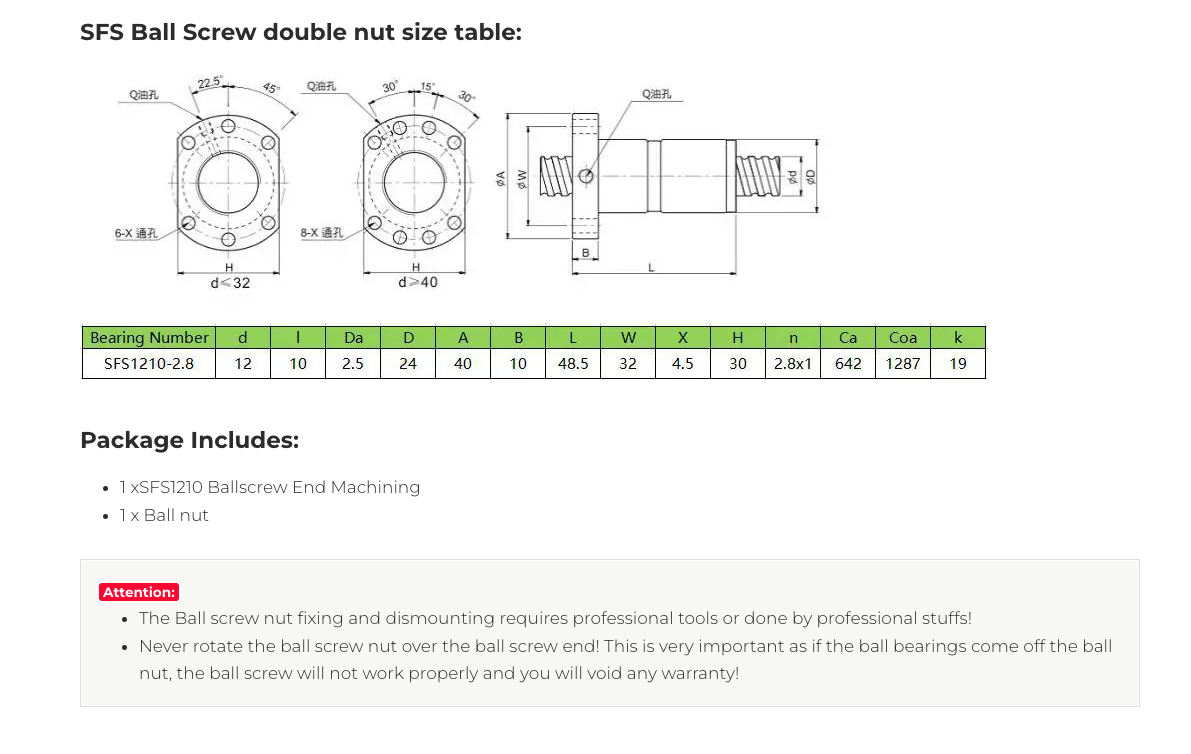
@m_c - are you able to say what they mean by the ball-screw mounting requiring professional tools (or "professional stuffs"!):
I'm strongly considering the Ultimate Bee with a 2.2 water cooled spindle and xPro V5 controller
Its worth watching this series to see if it's within your capabilities, but it's the sort of thing I think I would enjoy putting together. I watched them all on 2x playback as a virtual way of flipping through the manual
?si=iyikn9g6NCxnFu2r
Its worth watching this series to see if it's within your capabilities, but it's the sort of thing I think I would enjoy putting together. I watched them all on 2x playback as a virtual way of flipping through the manual
?si=iyikn9g6NCxnFu2r
looks like they come preassembled, so its a warning not to take them offgoldtop said:@m_c - are you able to say what they mean by the ball-screw mounting requiring professional tools (or "professional stuffs"!):
Oh, I see - it's a case of not doing the second bit because of the first bit.WezV said:looks like they come preassembled, so its a warning not to take them offgoldtop said:@m_c - are you able to say what they mean by the ball-screw mounting requiring professional tools (or "professional stuffs"!):
That video series looks perfect - bookmarked for later. Thanks.
I get positive vibes from this particular Chinese seller - lots of explanation and genuine acknowledgement of the origins and development of this design. Such as the Tingle Tension system (for the lead-screw Queenbee version).
This.WezV said:looks like they come preassembled, so its a warning not to take them offgoldtop said:@m_c - are you able to say what they mean by the ball-screw mounting requiring professional tools (or "professional stuffs"!):
If you unscrew most ball nuts of the screw, the balls will fall out. They can be re-assembled with a lot of patience, but some nuts will use alternating size balls, which means you also have the hassle of having to measure and sort every ball, before spending lots of time reinserting them.
For reference, if you do need to dismantle a nut, you need a bit round bar/tube that is the same size as the minor diameter of the screw, so that as you unwind the nut, the bar/tube holds the balls in the tracks of the nut. It's not a hard thing to do, but it's one of those jobs where you're only a little slip away from ending up with a pile of balls where you don't want a pile of balls!
Looking at the Genmitsu, Ooznest or similar CNC routers.